These paintings are derived from
Chinese characters or ideograms/ideographs. The particular ideogram was selected
not by meaning but by aesthetic pattern of line and spacings.
NOTE: All
reduced and overly processed images fail utterly in even
hinting at the quality and the true colors of the actual
paintings and their effect on the viewer.
Previous work involved Chinese
characters. See:
Calligraphy
Stylized calligraphy (2011-2012).
16 × 20 inches
Change, Painted Version
Hua-Yen, Painted Version
Unity: Not One, Not Two, Painted Version
Forest Dharma, Painted Version
Season Cycle, Painted Version
Land
Construction, Painted Version
Music, Painted Version
|
Debra Jan Bibel
MORPHOLOGIES:
An Exploration, An Evolution
Ideograms
|
A quaint textual device is starting
a document with an enlarged capital letter to a word. In medieval times, monks
would decorate the background of the Latin letters with paintings of floral
elements or scenes of people at work or animals. At times, the letter itself
becomes tranformed into a key part of the miniature. My latest series of
caligraphic derivations of Chinese ideograms is much like this tradition. For
the viewer unfamiliar with Chinese characters, the painting has a geometric
abstract appearance of the hard-edge school of art. For those who know Chinese
writing, the painting has an amusing quality of recognition and association.
Circles take the place of printed or brushed flourishes, which themselves are
often substitutes of radicals or complex arrays of brush strokes.
|
|
|
|
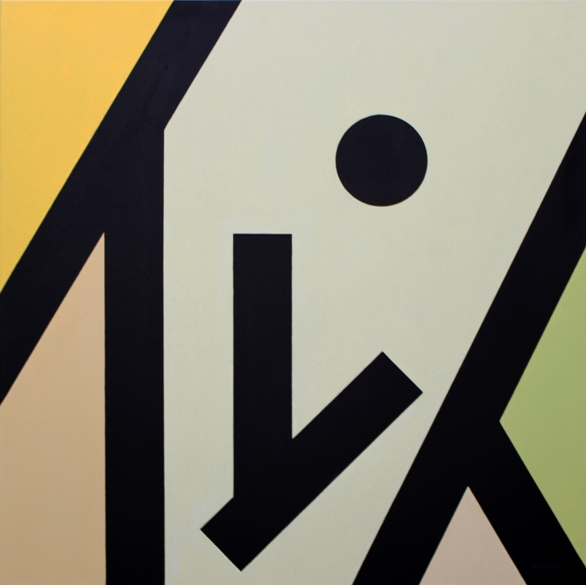 |
Kindred Spirits (2026) , 30 ×
30 in.
A more
modern abstract pattern from the
original character, which is associated with similarity,
likeness, resemblance, and equivalence. Pictorially,
when reduced to basic geometrics, the three intersected
linear elements do seem related.
Screen image
does injustice to the actual central background hue,
which varies in ambient light: in
bright shade it has only a tint of pale green, but in
reduced light the green is more obvious, darker, and
muted like adjacent hues for an even tone. The computer
processed imaged seems more 'parchment' in hue.
|
 |
 |
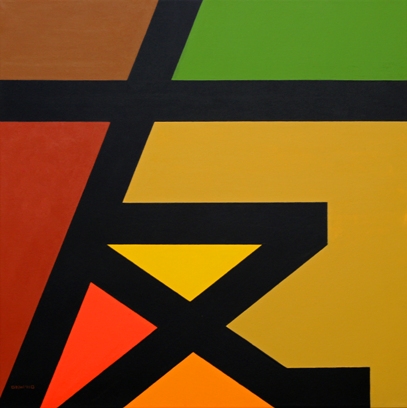
Friendship (2026) ,
24 × 24 in.
The seal
script of this character depicts two hands in agreement.
The standard character seems to have the hands crossed
or clasped.
Friendship
in this ideogram is indicated by the warmth of colors
and the group of triangles.
|
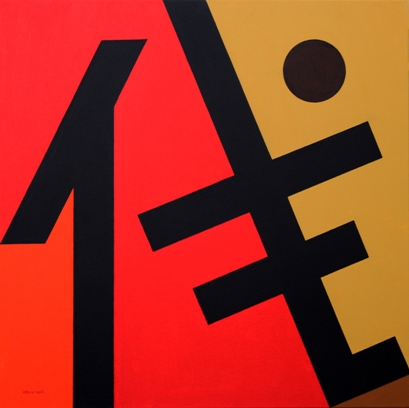
Hew (2026) ,
24 × 24 in.
The source
of this ideogram's right element is associated with
militaristic matters as its primitive forms represent a
spear and a halberd. The full character means to attack,
subjugate, destroy. However, a peaceful application of
the blade and expanded character definition is simply to
chop, slice, cut, and more specifically to cut down, as
trees for lumber. Hence, the painting,
Hew,
emphasizes this positive aspect but the colors suggest
the negative application as well.
|
|
 |
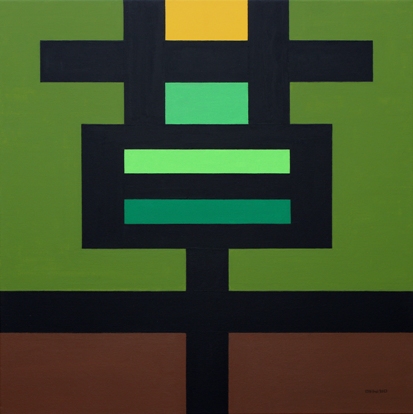 |
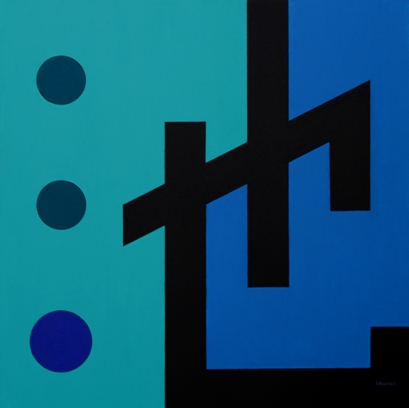
Reservoir (2026) ,
24 × 24 in.
This ideogram is associated with small bodies of water,
such as a pond, a pool, a moat, and a water tank.
Another such place is the title of the painting,
Reservoir.
|
Entheogen (2026) ,
24 × 24 in.
Associated
with grass, weeds, straw, and herbs, such plants include
psychedelics or entheogens. Informally, Cannabis, for
example, is called weed or grass. Thus, the painting is
appropriately entitled
Entheogen.
The yellow at top may be viewed as a flower or a
metaphor, or the entire form is a masked
indigenous deity akin to Hopi or Mayan.
|
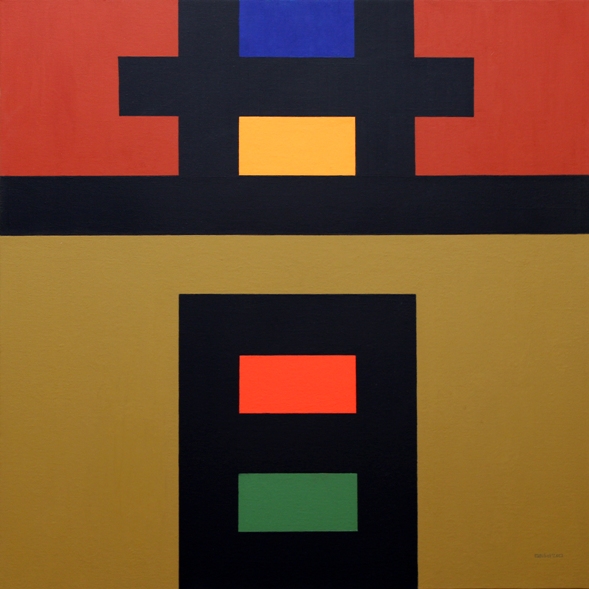 |
Antiquity (2026) ,
30 × 30 in.
Derived from Chinese for
old, antique, formerly. The bronze color and earthy
colors, with gemlike rectangles, suggest archeological
artifacts. |
|
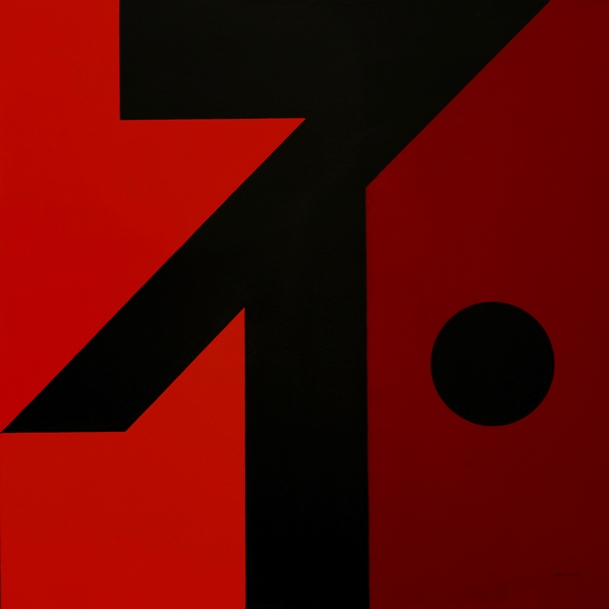 |
No (2026) ,
30 × 30 in.
Bold black on reds is the derived
character meaning no or not. On a recycled canvas,
No is painted
over a grid of circles, which in oblique light may be detected. The resulting
significance of this ideogram
on such a subtle,
largely hidden background is open to the viewer.
|
|
 |
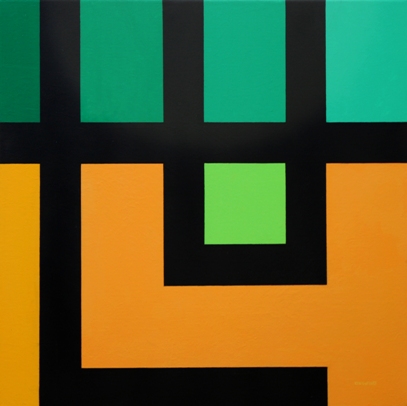 |
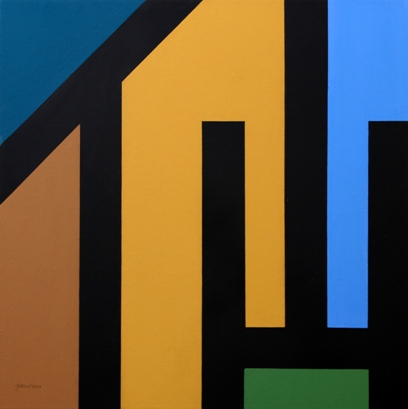
Mountain Hermit (2026) ,
24 × 24 in.
Mountains are
the legendary abodes of deities, geniis/jinns, but also
sages who are often depicted in front of caves. The Chinese
character is simply "mountain man" and is associated with
the Eight Immortals of Chinese mythology. In American
culture during the expansion of the nation, mountain men
were independent trappers of the fur trade and territorial
explorers.
Mountain Hermit
is more mundane.
|
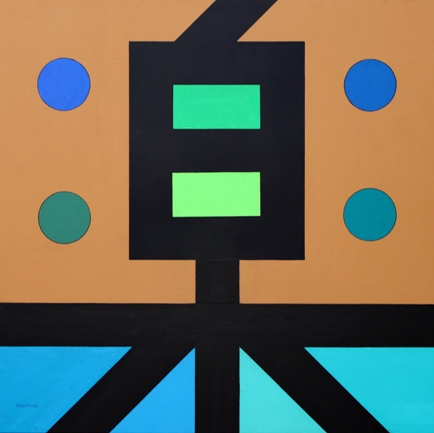
Lineage (2026) ,
24 × 24 in.
This
ideogram, which resembles the collision of three
plus-looking (+) characters each representing the number 10,
hence 30, is associated with a generation [30 years], an era,
and world, depending on context. [Chinese actually
juxtaposes the two characters for three and ten to mean
30.] Color patterns indicate the related meaning of
Lineage.
|
 |
 |
<
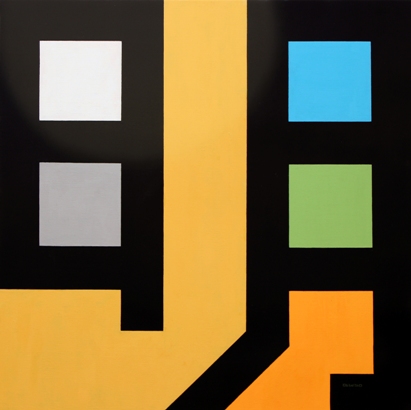
Music: La Mer (2026) ,
24 × 24 in.
Based on abbreviation of elements,
particularly in Japanese kanji, and symbolized further with circles is
Music: La Mer.
The character is associated with
music, pleasure, and happiness. The form is said to resemble a drum and bells on a wooden
stand.
|
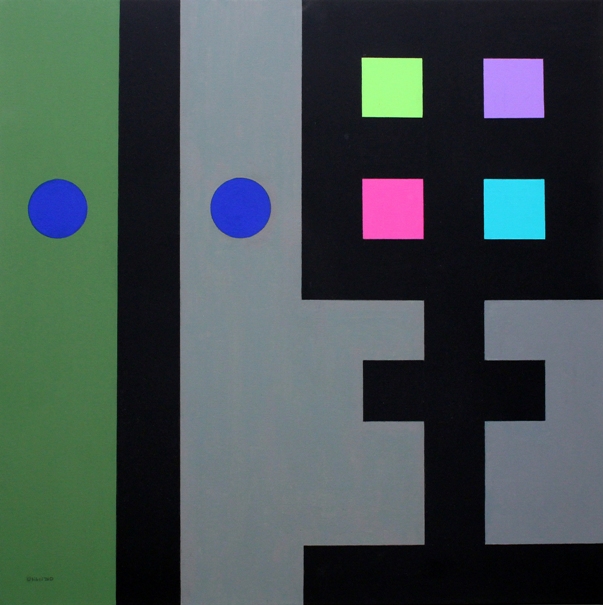
Into the Light (2026) ,
24 × 24 in.
Into the Light
can be viewed as a pathway with blocked distractions by those unfamiliar with
the Chinese character of light, bright, clear, evident. The two portions are
themselves radicals for sun and moon.
|
|
 |
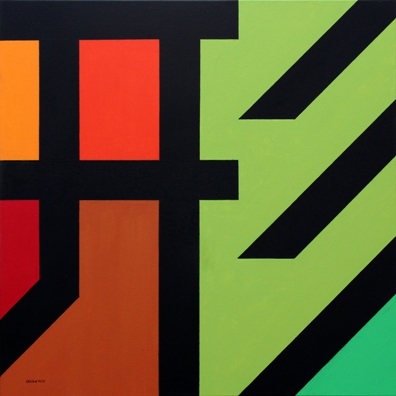
Gloom (2026) ,
30 × 30 in.
This somber ideogram
Gloom,
derived from the Chinese, is associated with sadness, grief, worry, and pity.
|
|
 |
 |
|
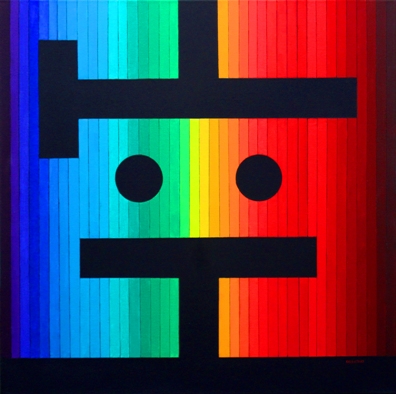
Form / Emptiness: form is emptiness, emptiness is form (2026) , each 24 × 24 in.
(left) Form
(right) Emptiness
The diptych
Form / Emptiness
are derived ideograms referring to the Buddhist Heart Sutra (the core of the
large philosophical Prajaparamita treatise), which states "form is emptiness,
emptiness is form." It points toward process metaphysics, behavioral attributes,
quantum fundamentals and observational dependency, concluding that existence is
not based on nouns or stuff but on gerunds, verbal actions that serve as nouns,
and are mutually dependent.
* *
*
In English, the first character is translated to "form," but Chinese has several
characters that are synonyms pertaining to form. The sutra ideogram itself,
found in Korea and Japan as well, variously means, appearance, or hue, or substance, or the
material world; however, artistically, aesthetically it is inferior to the one
substituted for this work, which means appearance, shape, and form by structure
or conceptual category. A third ideogram synonym might have worked in the sutra,
as it refers to domain, territory, boundary, or indeed the world itself,
everything in perceptive existence.
[The painting Form
is self-referential via brush strokes. The form of the Form ideogram has common
vertical brushing while the green background space is irregular, turbulent,
chaotic.]
The second stylized Chinese character in the sutra is typically translated as
emptiness or void or space or hole. These meanings imply duality in being absent
with respect to something. Another way to translate it, particularly for this
sutra (which presents paradox), is "no-thingness."
The background of this
painting Emptiness
suggests a rainbow or prismatic color spectrum. A rainbow from ancient times has
been a symbol of a non-thing thing. A rainbow is not a substance, but an
untouchable appearance dependent on the angle of observation [40-42°] with water
droplets serving as a prism that splits composite white light into the spread of
component hues. We nonetheless name that form and can describe it, hence
becoming perceptively real, but it does not exist alone.
In Daoism, Lao Tzu's treatise begins with "the Dao that can be named is not
Dao." In the Bible, the first act Adam assigned himself was to name the beasts
in the field and birds in the air, everything in the world, hence causing
separation and differentiation. In the quantum world, the packet of energy that
comes out of the void, or itself, can act as a particle that individually and
collectively behaves as a wave depending on observational/detectional design. In
the Hindu Upanishads, the expression is neti, neti, not this, not that. In the
common world, we concretize the metaphor.
* *
*
|
 |
 |
 |
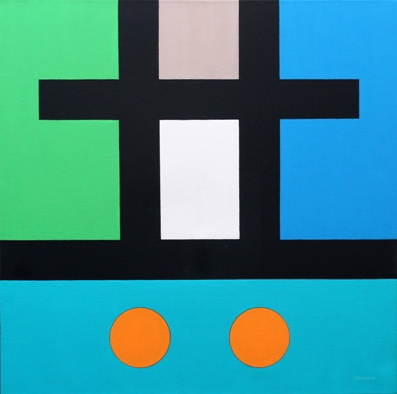 |
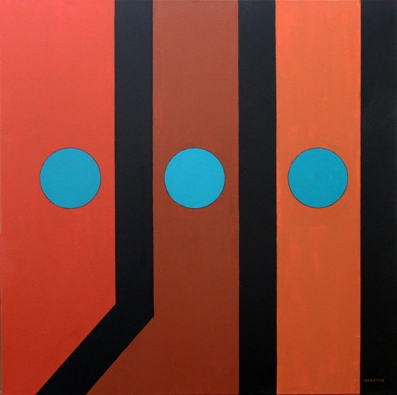
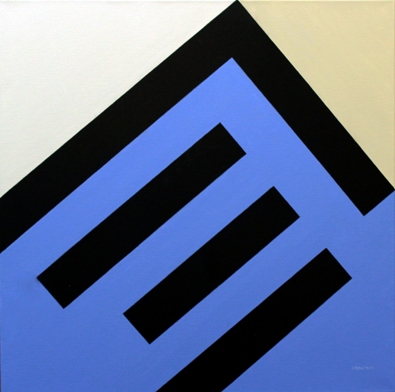
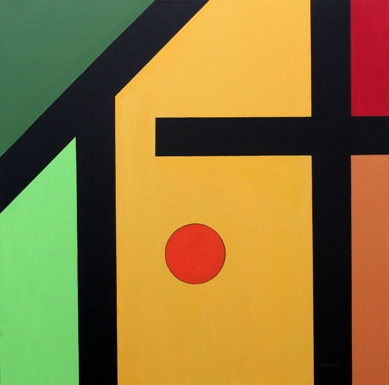
Quartet of
Ideograms (2026) , each 24 × 24 in.
Not proper
Chinese but separately ideograms mean community action /
give, pay, or compensate / wing / islands, shoals, or
continents, or more poetically
We all fly to the islands.
Links to
enlargements:
we
give
wing
islands
Quartet of Ideograms:
After a creative hiatus of 6 months during which the new book Resonance was
published, comes a return to Chinese ideograms in a different stylistic
exploration. Chosen for their spatial arrangement of strokes and spaces, not for
meaning, four ideograms serendipitously could be arranged, with poetic license,
to an interesting sentence.
|
|
All images are
copyright by Debra Jan Bibel. Permission for use in electronic media or
for printed reproduction is required.
Links to this website are permitted only if artist identification is included in
direct view, not just within source code.
|


   |